



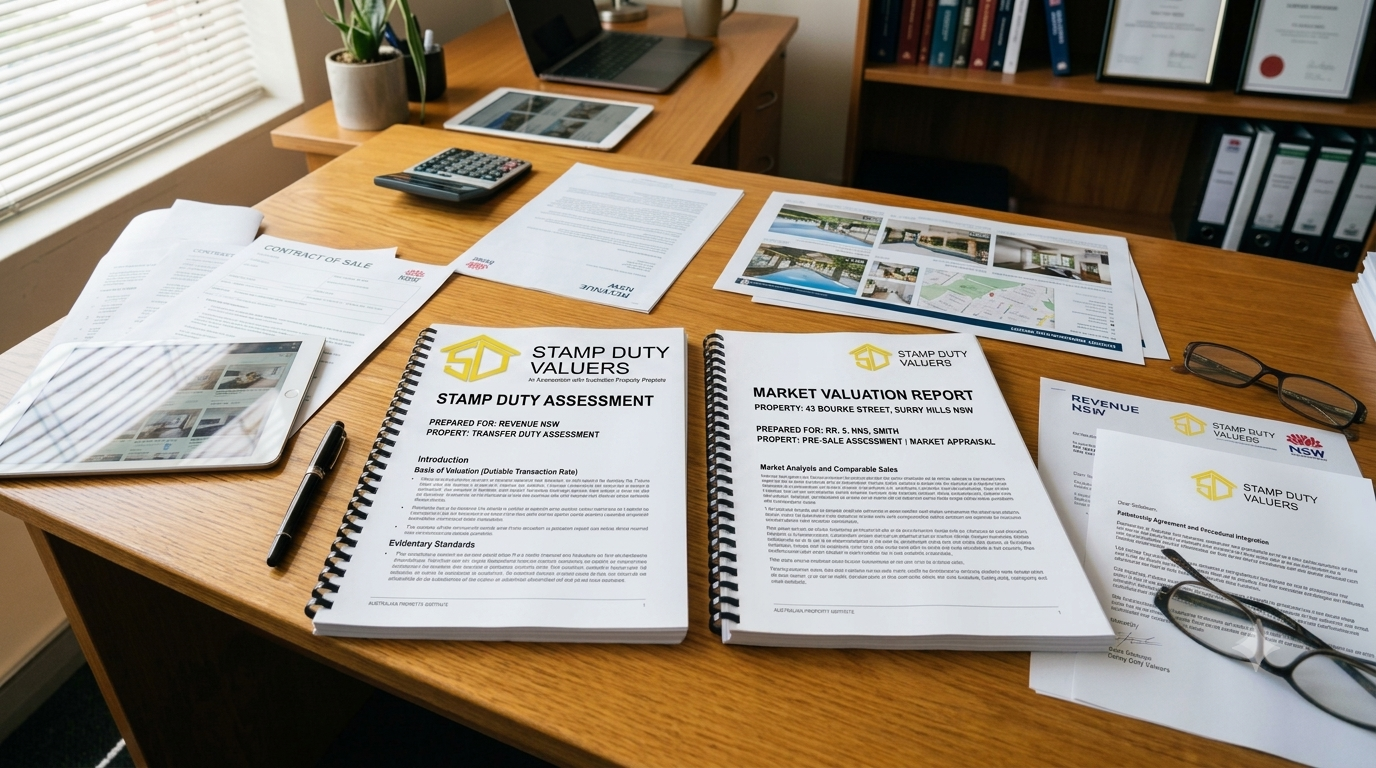
Stamp Duty Valuation vs Market Valuation: What Is the Difference
It is a reasonable assumption that any professional valuation report should work for any purpose. It is also wrong, and it catches out a surprising number of property owners every year. A stamp duty valuation and a general market valuation can both arrive at a similar dollar figure, yet only one of them is built to satisfy a revenue office, and using the wrong one can delay a transfer or trigger a duty reassessment.
This guide explains exactly what separates the two report types, when each one applies, and why love and affection transfers between family members are one of the clearest examples of where the distinction actually matters.
What a Stamp Duty Valuation Actually Is
A stamp duty valuation is an independent assessment prepared specifically to support the calculation of transfer duty on a dutiable transaction. The report states explicitly that its purpose is duty assessment, references the relevant date of the transaction, and is built to the evidentiary standard a revenue office expects if the figure is ever questioned.
This last point is what most people miss. The Australian Property Institute’s own professional conduct rules require a valuer to compile and verify sufficient relevant facts and data to support their conclusion. A report prepared loosely, without that level of evidentiary rigour, may state a perfectly reasonable opinion of value and still be rejected by a revenue office reviewing it for duty purposes.
What a General Market Valuation Is
A market valuation, sometimes simply called a property valuation or appraisal depending on who prepares it, is a broader category. It states an opinion of value but is usually commissioned for a different purpose entirely, lending security, a pre sale assessment, or general financial planning. It may use the same underlying methodology as a stamp duty report, but it is not structured or worded to address transfer duty requirements specifically.
Side by Side Comparison
| Factor | Stamp Duty Valuation | General Market Valuation |
| Purpose stated in the report | Explicitly prepared for transfer duty assessment | Usually prepared for lending, sale, or general advice |
| Accepted by the revenue office | Yes, when prepared correctly by a qualified valuer | Not automatically, even if technically accurate |
| Evidentiary standard | Must meet the disclosure standard expected in duty disputes | Not structured for this level of scrutiny |
| Effective date | Tied to the date of the dutiable transaction | Tied to whatever date the client requested |
| Typical commissioning party | Buyer, related party, trustee, or their solicitor | Lender, vendor, or property owner generally |
| Risk if used for the wrong purpose | Low, designed for this exact use | High, may be rejected or queried by the revenue office |
Why Love and Affection Transfers Make This Distinction Obvious
A love and affection transfer, the common term for a property gifted between family members for little or no payment, is the clearest example of why the two report types cannot be swapped. There is no contract price to fall back on, no agent involved, and no open market test of any kind. The revenue office has nothing to assess duty against except an independent opinion of value.
A market valuation prepared for, say, a parent’s general financial planning purposes might state a figure but will not necessarily be addressed to transfer duty, dated correctly to the transfer, or supported with the level of comparable sales analysis a revenue office expects to see. A stamp duty valuation closes every one of those gaps by design.
| Real Scenario |
| A mother wanted to transfer her family home to her son for love and affection, with no payment involved. Her son initially assumed the bank valuation obtained two years earlier for a refinance would be sufficient, since it stated a dollar figure for the property. When his conveyancer reviewed it, the report was dated to the wrong year, addressed to the bank rather than to duty purposes, and made no reference to the property’s current condition following a kitchen renovation completed since the refinance. A fresh stamp duty valuation was commissioned, dated to the actual transfer, and the conveyancer lodged the transfer without delay using a report that matched exactly what Revenue NSW required. |
Which Report You Actually Need
The right report depends entirely on what you are trying to achieve, not on which one happens to be cheaper or faster to obtain.
| If You Need This | Use This Report |
| To calculate duty on a related party transfer | A stamp duty valuation, explicitly addressed to transfer duty purposes |
| To refinance or secure a loan | A lender commissioned bank valuation |
| To list a property for sale | A real estate agent appraisal, or a market valuation if independence matters |
| To settle a family law property dispute | A market valuation prepared for family law purposes specifically |
| To support an SMSF related party purchase | A stamp duty valuation may be needed for the transfer, alongside a separate SMSF compliance valuation |
Can One Report Be Adapted for the Other Purpose
Sometimes a high quality market valuation can be adapted or relied upon in a duty context, but this is not guaranteed, and a revenue office will often still expect a report that explicitly addresses transfer duty requirements. The safer and ultimately more efficient approach is to commission the correct report type for the purpose from the outset rather than hoping an existing report will be accepted.
Conclusion
A stamp duty valuation and a market valuation can look similar on the surface, a dollar figure backed by comparable sales, but they are built for different audiences and different standards of scrutiny. For family transfers, gifts, trust restructures, and any related party transaction, the stamp duty specific report is the one that protects you from a revenue office dispute, while a general market valuation remains the right tool for lending, sale, or planning purposes.
| Get the Right Valuation for Your Transfer Stamp Duty Valuers prepares independent, purpose specific reports for family transfers, trusts, SMSF and related party transactions across NSW, VIC, QLD, and nationwide. Free quote confirmed within one business day. |
Frequently Asked Questions
Is a stamp duty valuation more expensive than a standard market valuation?
Pricing is generally comparable for similar property types. The difference is in how the report is prepared and worded, not necessarily the fee, since both require a site assessment and comparable sales analysis.
Can I use a real estate agent’s appraisal as my stamp duty valuation?
No. An agent’s appraisal is an informal opinion, not an independent valuation, and revenue offices do not accept it as evidence of market value for duty purposes.
My accountant gave me a property value for tax planning, can I use that for stamp duty?
Not directly. A figure used for general accounting or tax planning purposes is not the same as a stamp duty valuation prepared by a qualified valuer addressing transfer duty requirements specifically. A dedicated report is needed.
Does a love and affection transfer always require its own valuation?
In almost every case, yes. Without a contract price or arm’s length sale to rely on, market value determined by an independent valuer is the only available basis for assessing duty.
If I already have a recent market valuation, do I still need a separate stamp duty report?
It depends on how the existing report is worded and dated. If it explicitly addresses transfer duty, is dated within the accepted timeframe, and meets the evidentiary standard expected, it may be sufficient. In most cases a purpose specific report is the safer option.
Who typically commissions the stamp duty valuation in a family transfer?
Usually the person receiving the property, often acting on advice from their solicitor or conveyancer, who will specify exactly what the report needs to state to satisfy the relevant revenue office.