


Easement Valuation During Land Subdivision and Boundary Changes
If you’re subdividing a block, consolidating lots, or straightening out a wonky boundary, there’s a good chance an easement is sitting somewhere in the middle of your plans. Maybe there’s an old drainage easement running through where you want to put a driveway. Maybe council wants a new easement created before they’ll approve your plan of subdivision. Or maybe a neighbour’s right of carriageway crosses the exact spot your surveyor has marked for the new boundary line.
Whatever the trigger, the question that follows is usually the same one: what’s this easement actually worth, and who pays whom?
This is where understanding the impact of easements on property value comes in. It’s a specific type of property valuation that measures how much an easement affects the value of the land it sits on (and sometimes the land it benefits), so that compensation, negotiations, or council conditions can be worked through on a defensible, evidence-based footing rather than a guess.
In this guide, we’ll walk through what easement valuation actually involves during subdivision and boundary changes, how valuers approach the assessment, what tends to trip people up, and when it’s worth bringing in an independent valuer rather than relying on a rough estimate from your surveyor or conveyancer.
Summary: The Short Version
Subdividing land or adjusting a boundary can trigger the need for a new easement, the repositioning of an existing one, or its extinguishment altogether — and any of these can affect what compensation is owed and to whom.
Easement valuation typically uses a “before and after” approach: valuing the affected land as if the easement didn’t exist, then valuing it again with the easement in place, with the difference forming the basis of compensation or the value adjustment.
The process for creating or changing an easement differs by state — in NSW it usually runs through a Section 88B instrument lodged with the plan; in Victoria it’s typically handled through the plan of subdivision and, where needed, a Section 173 agreement; other states have their own equivalents.
Stamp duty, GST and capital gains tax treatment can vary depending on whether money changes hands for the easement and how the arrangement is structured, so it’s worth getting advice specific to your situation rather than assuming a blanket rule applies.
An independent valuation earns its keep when there’s a genuine dispute, a council or authority is involved, family or neighbours are negotiating compensation, or a lender needs evidence the subdivision still stacks up once the easement is accounted for.
What Is Easement Valuation in a Subdivision Context?
An easement is a legal right that allows someone — a neighbour, a council, a utility provider — to use part of your land for a specific purpose, even though you still own it. Common examples include:
- Drainage easements, allowing stormwater or sewer pipes to run under a property.
- Rights of carriageway, giving a neighbouring lot access across your land to reach a road.
- Easements for services, covering power lines, water mains or telecommunications infrastructure.
- Easements for support, common in older terrace or semi-detached properties where one building physically relies on another for structural support.
The land that has the benefit of the easement is called the dominant tenement. The land that carries the burden of it is the servient tenement.
Easement valuation is simply the process of working out how much that burden (or benefit) is worth in dollar terms. During a subdivision or boundary change, this usually comes up in one of two ways: an existing easement needs to be assessed because the subdivision affects it in some way, or a brand-new easement needs to be created as a condition of the subdivision going ahead, and someone needs to work out fair compensation for granting it.
Either way, a valuer looks at how the easement changes what the burdened land can realistically be used for — and prices that impact.
How Easements Get Created or Changed During Subdivision
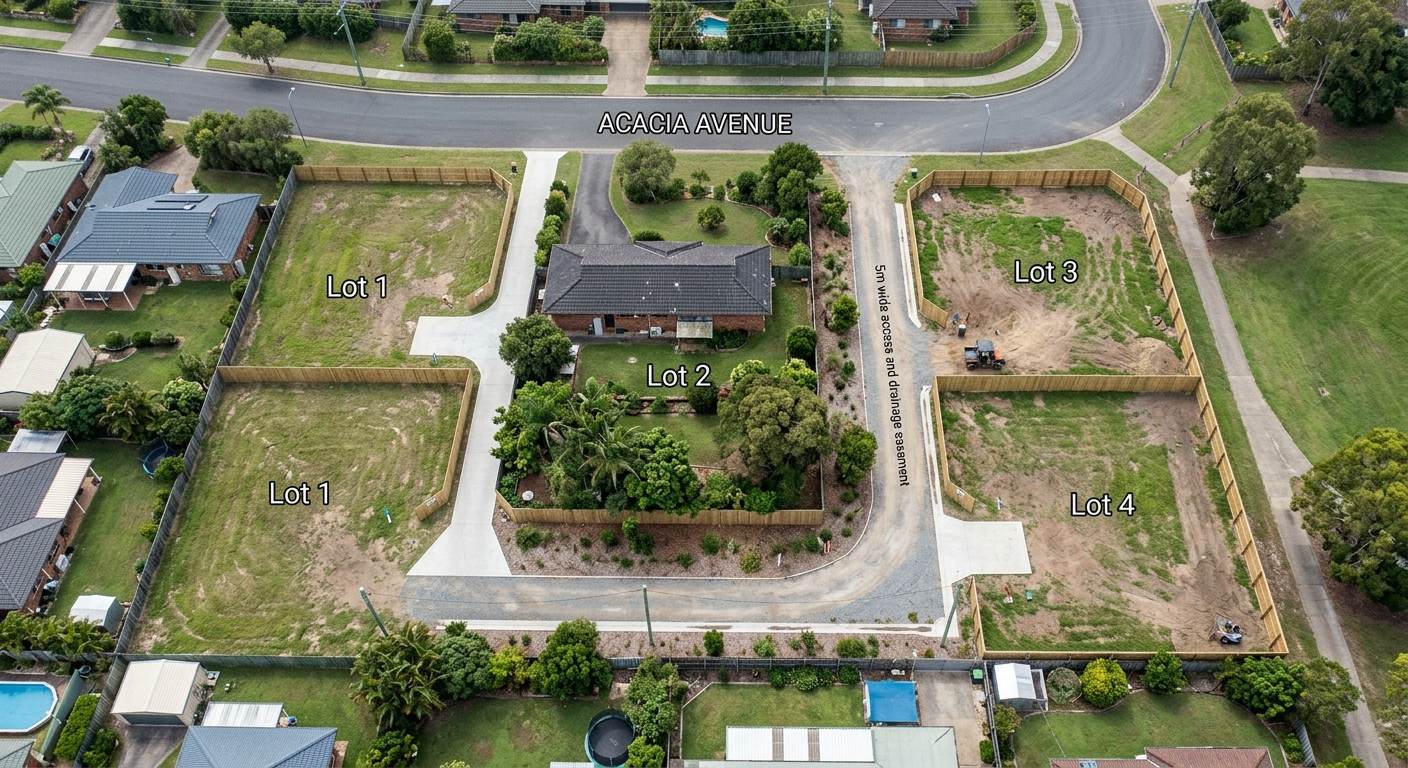
Subdividing land often means new easements have to be registered, not just because a valuer or lawyer decided they were a good idea, but because council, water authorities or electricity distributors require them as a condition of approval. Access tracks, stormwater lines and shared driveways all typically need a formal easement before a plan of subdivision will be registered.
The legal mechanics differ from state to state:
- New South Wales: easements are usually created through a Section 88B instrument requirements process lodged alongside the deposited plan. This document, prepared by a solicitor or conveyancer working from the surveyor’s plan, sets out exactly what the easement allows and which lots are burdened and benefited. Registering an 88B instrument itself doesn’t attract stamp duty.
- Victoria: easements are typically shown on the plan of subdivision under the Subdivision Act 1988. Where council wants more control over how land is used or maintained beyond a standard easement, a Section 173 agreement may also be registered on title.
- Queensland, Western Australia, South Australia and other states: each has its own subdivision legislation and registration process, generally requiring the easement to be defined on the survey plan and formalised through the relevant land titles office.
Because the rules genuinely differ between jurisdictions, it’s worth checking the specific requirements with a local surveyor or property lawyer rather than assuming what applies in one state applies everywhere.
When You Need an Easement Valuation During a Subdivision or Boundary Change
Not every subdivision needs a formal easement valuation. But a few scenarios come up often enough that they’re worth flagging:
A new easement is being created for the subdivision to proceed
If council or a utility requires a new drainage, access or services easement across part of your land (or a neighbour’s) as a condition of the subdivision, the burdened owner is often entitled to compensation — or, if it’s your own land being burdened, you’ll want to understand how much value the easement takes off that portion before you agree to it.
An existing easement is being repositioned
Sometimes a subdivision or boundary realignment means an existing easement no longer lines up with the new lot boundaries, and it needs to be relocated. The affected parties usually need to agree not just on the new location but on whether the relocation changes the value impact — a driveway easement moved closer to a house, for instance, can be more disruptive than the original alignment.
Boundary realignment affects land already burdened by an easement
If you’re straightening a boundary between two lots and one of them already carries an easement, the realignment can change how much of the easement sits on each side, which affects apportionment of value and, in some cases, compensation between the parties.
An easement is being extinguished
Occasionally a subdivision creates the opportunity to removing an unwanted easement from a property title that’s no longer needed — say, an old easement for a pipeline that’s since been decommissioned. Extinguishing an easement can increase the value of the previously burdened land, and the dominant owner (if there still is one) may be entitled to compensation for giving up that right.
There’s a dispute between neighbours or with an authority
Where the parties can’t agree on what an easement is worth — a common flashpoint when a council or utility wants to acquire an easement compulsorily — an independent valuation, ideally from a Certified Practising Valuer, is the standard form of evidence used to support a compensation claim or negotiate a settlement.
How Valuers Assess the Impact of an Easement
The most widely used approach is the “before and after” method. In simple terms:
- The valuer assesses the market value of the affected land as though the easement didn’t exist — its unencumbered value.
- The valuer then assesses the market value of the same land with the easement in place, taking into account everything it restricts.
- The difference between the two figures is the value impact of the easement, which forms the basis for compensation or the adjustment applied to the land’s value.
Courts in several states, including in NSW compensation cases under the Land Acquisition (Just Terms Compensation) Act 1991, have generally treated the before-and-after approach as the preferred method, alongside consideration of what the dominant owner could realistically do with the rights the easement gives them.
What actually drives the value impact
A few factors tend to matter most:
- How much usable land is lost. An easement across the back corner of a large rural block has a very different impact to one running through the middle of a small suburban lot.
- What building or development potential is affected. If the easement stops you building a garage, pool or extension in that spot, and that’s land you’d otherwise have used, the impact is usually greater.
- Whether the easement is visible or below ground. A buried drainage pipe with no surface impact is generally less disruptive than an overhead power easement or a driveway that changes how the land looks and functions.
- Consequential effects on the rest of the property. Sometimes an easement doesn’t just affect the strip of land it sits on — it can affect access, privacy, or the layout of the remaining lot, and a thorough valuation accounts for that too.
Because these factors vary so much from property to property, generic percentage rules of thumb aren’t reliable — a figure that’s reasonable for a rural drainage easement won’t necessarily hold up for a suburban carriageway easement, which is exactly why a site-specific valuation matters more than a rough guess.
Boundary Changes and Easements: What to Watch For
Boundary realignments (sometimes called boundary adjustments) are common when neighbours want to tidy up an awkward property line, correct a historical survey error, or make better use of land on either side of a fence. They’re usually simpler than a full subdivision, but easements can still complicate them.
A few practical points worth knowing:
- Check the title before you plan anything. A title search and, ideally, a copy of the relevant deposited plan or Section 88B instrument (in NSW) will show any existing easements affecting either lot.
- A boundary realignment can shift how much of an easement sits on each lot. This matters if compensation or maintenance obligations were originally apportioned based on the old boundary.
- New survey pegs don’t automatically move easements. An easement’s location is defined by the registered plan, not by where the current fence happens to sit — moving the boundary doesn’t relocate the easement unless that’s specifically documented and registered.
- Get the surveyor and a property lawyer involved early. Realigning a boundary that interacts with an easement usually needs both a survey and updated legal documentation, not just a valuer’s report.
Stamp Duty, Compensation and Other Costs
The tax and duty treatment of easements created or varied during subdivision depends heavily on the specifics of the transaction and the state involved, so this section is necessarily general — always confirm your position with a solicitor, accountant or your state revenue office before relying on it.
A few general points that tend to hold true:
- In NSW, registering a Section 88B instrument to create an easement as part of a subdivision doesn’t itself attract stamp duty, but duty may still apply if money or other consideration changes hands for the granting of the easement, depending on how the arrangement is structured.
- Where compensation is paid for granting or extinguishing an easement, there can be capital gains tax implications for the party receiving payment — this is a genuinely case-specific area, so specialist tax advice is worth getting rather than assuming a standard treatment applies.
- Beyond duty and tax, budget for the practical costs of dealing with an easement during a subdivision: survey fees, legal fees for preparing or reviewing the instrument, and — where compensation or a dispute is involved — the cost of an independent valuation.
Common Misconceptions About Easement Valuation
“The easement only affects a small strip, so it’s barely worth anything.”
Size isn’t the only factor. A narrow easement across a driveway or building envelope can restrict development potential far more than a wider one across an unused corner of a large block.
“Because it’s underground, it doesn’t affect value.”
Underground easements (like drainage or sewer lines) still typically restrict what can be built above them, which matters a great deal if that’s exactly where you planned to put a structure.
“Council’s valuation figure is the final word.”
Council or an authority’s own figure is a starting point for negotiation, not necessarily the market value — landowners are generally entitled to obtain their own independent valuation, particularly where compensation is being negotiated or disputed.
“Once the plan of subdivision is registered, the easement details can be sorted out later.”
Easements need to be correctly defined and, in most states, registered as part of (or before) the subdivision — trying to fix easement documentation after registration is usually far more complicated and costly than getting it right up front.
Getting a Professional Easement Valuation
Not every easement needs a formal, independent valuation — plenty of straightforward drainage or service easements created as a routine condition of subdivision get sorted out by the surveyor and solicitor without much fuss. But it’s worth getting a qualified, independent valuer involved when:
- You’re negotiating compensation with a council, utility or authority and want evidence to support your position.
- Neighbours or family members disagree on what an easement is worth as part of a subdivision or boundary change.
- A lender wants confirmation the subdivided lots still stack up financially once the easement’s impact is accounted for.
- You’re assessing the feasibility of a subdivision and need a realistic picture of value before committing to survey and legal costs.
A valuer who regularly deals with subdivisions and easements will look beyond the raw square metreage and consider how the easement genuinely affects what you (or a future buyer) can do with the land — which is usually the difference between a figure that holds up in a negotiation and one that doesn’t.
FAQs
Does creating an easement during a subdivision always require compensation?
Not always. If you’re creating the easement yourself as part of your own subdivision (for example, a shared driveway easement between two new lots you own), there may be no separate compensation required. Compensation becomes relevant when a third party — a neighbour, council or utility — is either burdened by a new easement or loses the benefit of an existing one.
Who pays for the easement valuation — the person creating the easement or the person affected by it?
This varies by arrangement and, where a compulsory process is involved, by legislation. In many negotiated situations, the party seeking to create or vary the easement covers the cost of the valuation, but this is a matter for agreement or, in disputed cases, for the relevant compensation framework to determine.
Can an easement reduce my property’s value even if I never use that part of the land anyway?
Yes. An easement restricts what could be built or done on that section of land in future, even if you have no current plans for it, and that restriction can still be reflected in market value — particularly if it limits extensions, outbuildings or future subdivision potential.
Does a right of carriageway get valued differently to a drainage easement?
Generally, yes. A right of carriageway usually has an ongoing, visible impact — vehicles crossing the land — while a drainage easement is often invisible day to day but restricts building over it. Valuers weigh up the practical, visible impact alongside the development restriction, so the two won’t necessarily attract the same value adjustment even if they cover a similar area.
Do I need a survey as well as a valuation?
Usually, yes. A survey establishes exactly where the easement sits and how much land it covers — the valuer then uses that information, alongside market evidence, to assess the value impact. The two professions do different jobs and generally work from the same plan.
Conclusion
Easements rarely derail a subdivision outright, but they do shape what compensation is fair, what a lot is really worth, and how a boundary change plays out on paper versus on the ground. Getting the valuation right — using a proper before-and-after assessment rather than a rough guess — gives everyone involved, from neighbours to councils to lenders, a defensible number to work from.
Need Help With an Easement Valuation?
If you’re working through a subdivision or boundary change and need an independent easement valuation, Stamp Duty Valuers can help you understand the value impact and put together evidence to support negotiations, council requirements or compensation discussions. You can reach the team on +61 438 080 786 to talk through your situation.